 English

Thermal graphite materials offer new technical solutions for the increasingly diverse industrial cooling applications across various thermal management scenarios. Currently, graphite sheets on the market are predominantly artificially synthesized. The raw material thickness of graphite sheets is typically limited to a maximum of 40μm; increasing thickness requires layering multiple sheets. The prevailing method involves bonding with double-sided adhesive tape, which introduces significant thermal resistance, substantially reducing the graphite sheet's cooling efficacy. Additionally, graphite sheets suffer from poor flexibility, susceptibility to wrinkling, inability to bend, powder shedding, complex processing requirements, and the need for edge wrapping and film lamination.
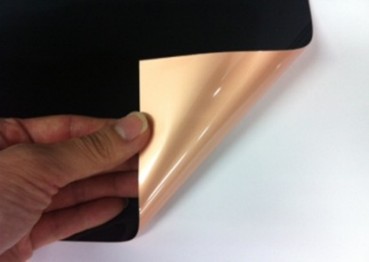
Addressing the limitations of traditional graphite sheets and the constrained thermal management space in electronic devices, our company has developed a novel graphene-enhanced copper foil tape—the MINORU CSTxx series. To achieve superior thermal conductivity and flexibility, we selected rolled copper foil with enhanced bend resistance as the substrate. A graphene layer is then coated onto the copper foil surface to optimize horizontal heat dissipation. The product structure diagram is as follows:
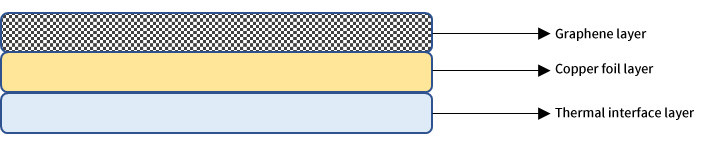
Copper foil not only conducts heat but also provides excellent electromagnetic shielding. Additionally, its superior bend resistance and wide range of thickness options make it suitable for thermal management across diverse applications. Furthermore, graphene-enhanced copper foil offers significant cost advantages, making it increasingly popular.
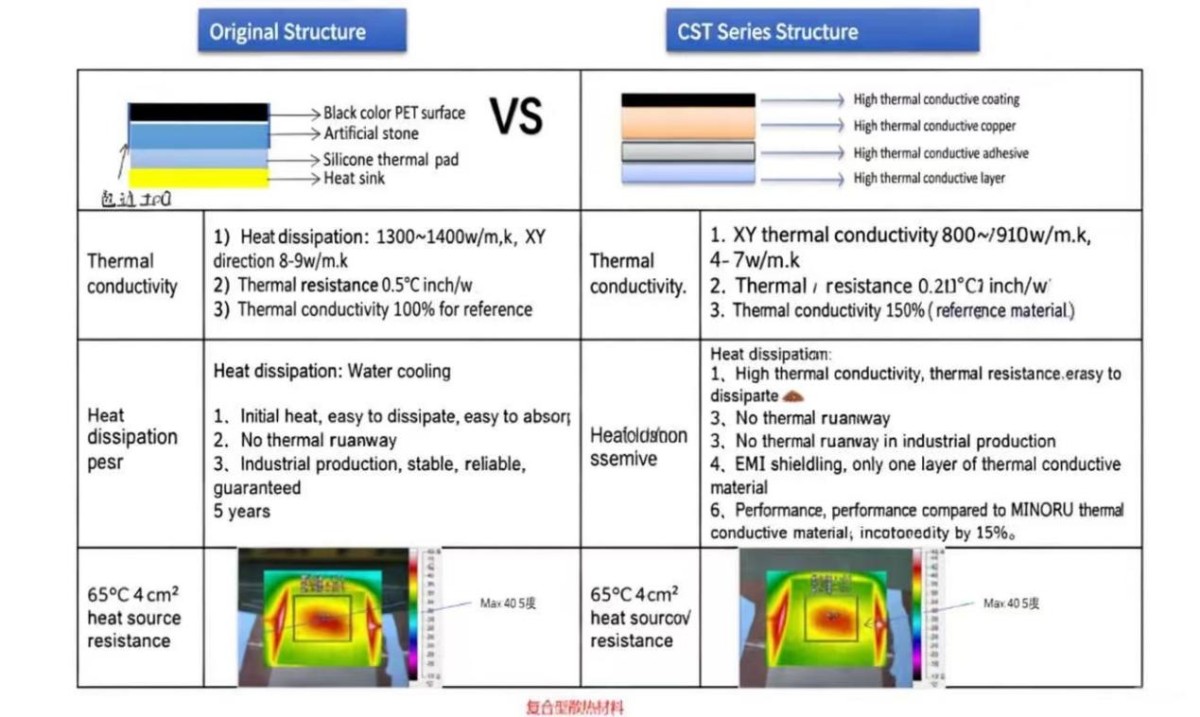
MINORU CSTxx series is commonly used in the following scenarios: thermal diffusion on flat panel displays, such as LED backlighting for LCD modules and OLED modules; thermal diffusion for lighting, photovoltaic, and charging modules; thermal diffusion on LED substrates; thermal diffusion for smartphone LCD modules; and chip cooling for COF/COP packaging. The image below shows MINORU CST08 used for edge cooling in automotive infotainment systems.
Online Message
Please give us a message